





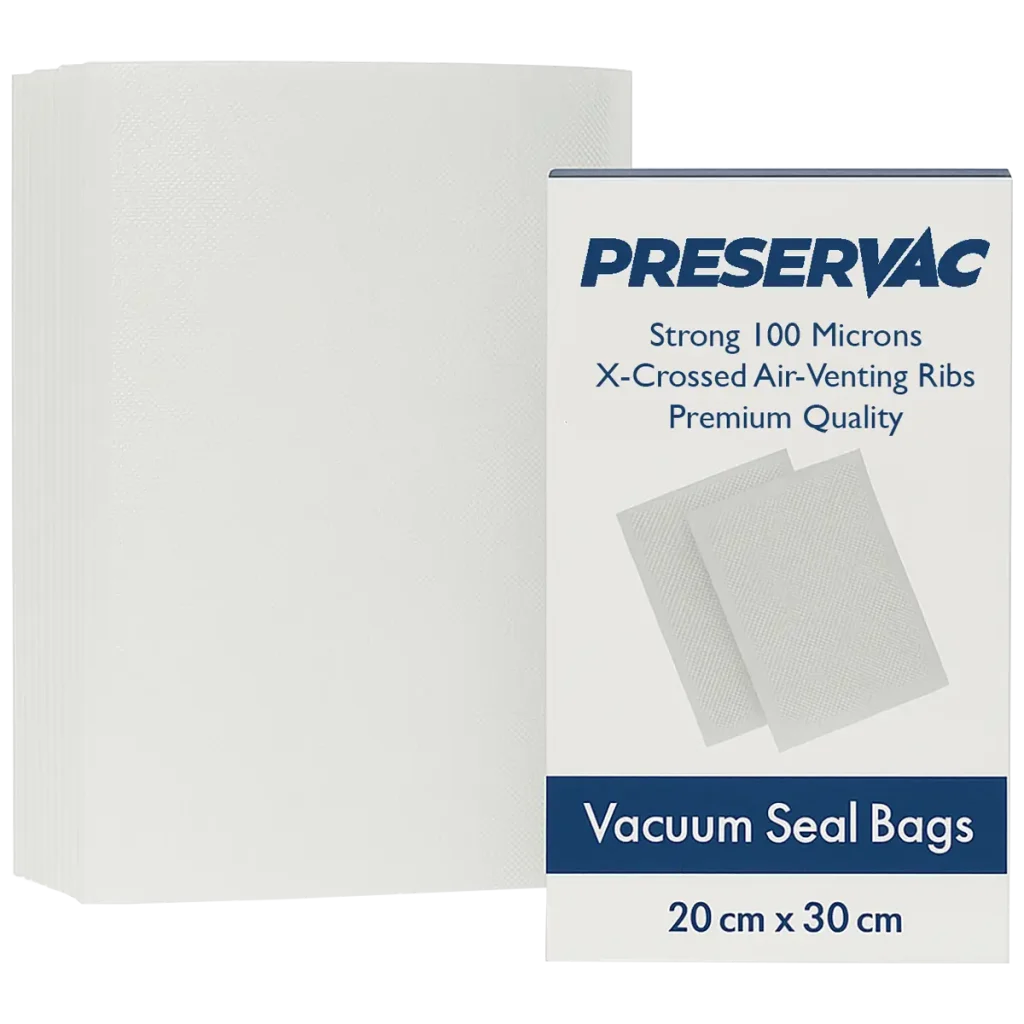


LAVA ES-Vac 20cmx6m Vacuum Seal Rolls | 2 Rolls
LAVA ES-Vac 20cm x 6m Vacuum Seal Rolls provide heavy-duty, cut-to-length packaging for bone-in meat, fish with hard fins, game portions, shell-on seafood and products with sharp or rough edges.
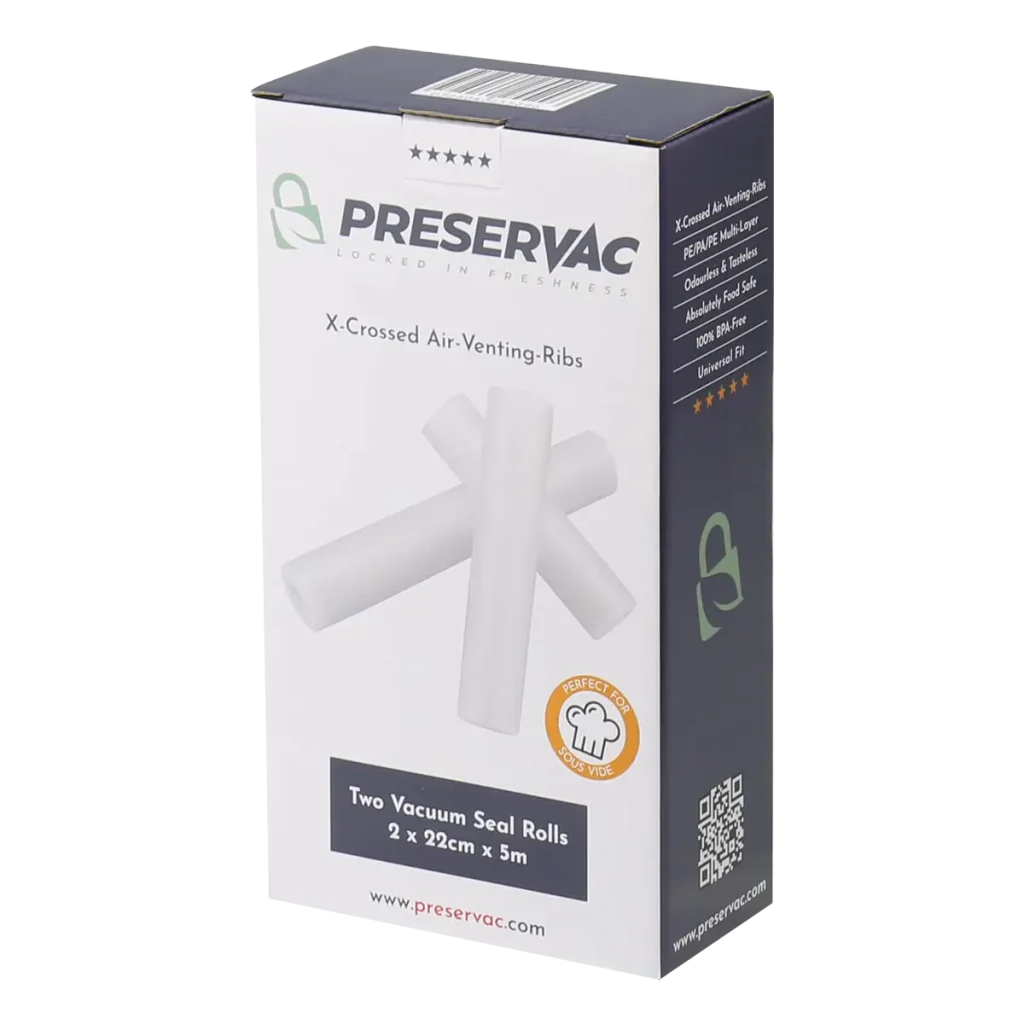
Each pack contains two rolls measuring 20cm wide and 6 metres long, providing 12 metres of vacuum packaging material in total.
The adjustable length makes the rolls suitable for both compact portions and longer products that do not fit standard pre-cut bags.
ES-Vac rolls are manufactured in Switzerland from 160 micron multilayer PA/PE film.
This is approximately 75% thicker than the standard 90 micron E-Vac range.
One side contains LAVA’s patented fleece-style structure for air removal, while the opposite side remains smooth and transparent.
Choosing Between ES-Vac Widths
The 20cm option is a practical everyday heavy-duty width. Choose it for portions that need more room than 15cm but do not require the wider 25cm or 30cm rolls.
Narrow products
Cutlets, sausages and prawns
Everyday heavy-duty width
T-bone steaks, chops and small fish
Larger portions
Broad fish and game portions
Wide heavy-duty packages
Large fish, poultry and roasts
Practical Heavy-Duty Width
- 20cm roll width
- Two 6-metre rolls per pack
- 12 metres of total packaging material
- Cut-to-length format for varied portions
160 Micron ES-Vac Film
- Approximately 75% thicker than E-Vac
- Patented fleece-textured side
- Smooth transparent side for inspection
- Suitable for freezer storage and short sous vide use
Specifications
| Brand | LAVA |
|---|---|
| Product Range | ES-Vac |
| Product Type | Heavy-duty cut-to-length vacuum seal rolls |
| Roll Width | 20cm |
| Length Per Roll | 6 metres |
| Quantity | 2 rolls per pack |
| Total Material Length | 12 metres |
| Film Thickness | 160 microns |
| Standard E-Vac Thickness | 90 microns |
| Relative Thickness | Approximately 75% thicker than E-Vac |
| Material | Multilayer PA/PE film |
| Surface Structure | Patented fleece-textured side with one smooth side |
| Closure Method | Cut to length and heat seal both open ends |
| Food-Safe | Yes |
| BPA-Free | Yes |
| Plasticiser-Free | Yes |
| Microplastic-Free | Yes |
| Odourless And Tasteless | Yes |
| Freezer Safe | Yes |
| Freezer Storage | Suitable for extended and multi-year storage when correctly sealed |
| Dishwasher Safe | Yes |
| Reusable | Yes, when hygiene and remaining length allow |
| Maximum Temperature | Up to 95°C |
| Microwave And Boiling Safe | Yes, up to 95°C |
| Sous Vide Safe | Yes, up to 95°C for up to 2 hours |
| Minimum Sealing Width | At least 20cm |
| LAVA Machine Compatibility | Compatible with all LAVA vacuum sealers |
| Other Machine Compatibility | Machine must reliably seal 160 micron structured film |
| Available ES-Vac Widths | 15cm, 20cm, 25cm and 30cm |
| Country Of Origin | Switzerland |
A Practical Heavy-Duty Width For Everyday Portions
The 20cm ES-Vac roll combines an everyday bag width with the stronger film required for bones, fins and hard edges.
It provides more side clearance than the narrow 15cm ES-Vac roll while avoiding the unused film that may remain when ordinary portions are packaged inside a 25cm or 30cm roll.
Suitable applications include T-bone steaks, bone-in pork chops, bone-in chicken breasts, individual rib portions, small whole fish, spiny fish portions, shell-on seafood, venison and game cuts, hardware and small industrial components, and products intended for demanding freezer storage.
The product should enter without stretching the roll or pressing firmly against both sides.
Enough clean material must also remain above it for the vacuum channel and final seal.
For other heavy-duty widths, browse the heavy-duty vacuum seal rolls range.
160 Micron Film For Bones And Sharp Edges
Standard vacuum film may be damaged when the material tightens around exposed bones, fish spines, shells, hard frozen corners or rough product surfaces.
ES-Vac uses 160 micron film, compared with 90 microns for standard E-Vac.
The added material improves resistance to punctures, tearing and abrasion during vacuuming, handling and freezer storage.
A weak point may not become visible during the initial sealing cycle.
A bone or hard edge can continue pressing against the film after the food freezes, becomes rigid or is stacked beneath other products.
The thicker material reduces this risk, but the rolls should not be described as completely puncture-proof.
Extremely sharp bones, shell points, hooks, clips and metal edges should still be removed, covered or repositioned before sealing.
Suitable For T-Bone Steaks
A T-bone steak contains a central bone with hard edges that may press directly against the bag when the air is removed.
The 20cm width suits many individual T-bone portions, depending on the width and thickness of the steak.
The meat should slide into the bag without forcing the sides apart.
Position the sharpest end of the bone away from the side seams and the bottom weld.
Add food-safe bone protection when a cut edge remains particularly sharp.
Pat the steak dry before placing it inside the bag.
Keep blood, fat, seasoning and food particles away from the inside of the open end.
LAVA specifically identifies T-bone steaks and comparable bone-in portions as suitable applications for the 20cm ES-Vac roll.
Bone-In Pork Chops And Rib Portions
Bone-in pork chops and individual rib portions can place several hard pressure points against vacuum film.
The 160 micron construction provides added protection where the bag tightens around a bone end or joint.
Arrange the portion so the bone does not press directly into a corner or side edge.
A flat arrangement normally allows air to move more evenly around the food.
For several rib portions, avoid building a thick stack.
Overlapping cuts can trap air between them and create uneven pressure across the bag.
Move to a 25cm ES-Vac roll when the food presses tightly against both sides or leaves insufficient room for the film to settle naturally.
Bone-In Chicken Breasts And Poultry Portions
The 20cm width can accommodate selected bone-in chicken breasts, thighs, drumsticks and compact poultry portions.
Chicken joints and cut bone ends can puncture thinner packaging during the vacuum cycle or later during freezer storage.
Place the portion so the exposed bone faces away from the side seams.
Remove any loose fragments before sealing.
Poultry can release significant moisture as the vacuum tightens the bag.
Chill the food before packaging and leave additional clean material between the chicken and the opening.
Use manual or pulse control when available and stop the cycle before liquid reaches the machine.
Small Whole Fish And Spiny Fish
The 20cm roll is suitable for small whole fish and narrow seafood portions that fit comfortably inside the opening.
Fish with dorsal fins, spines or hard tail edges may damage standard 90 micron packaging.
The thicker ES-Vac film provides more protection at these contact points.
LAVA identifies whole small fish, flathead and other spiny fish as suitable uses for this size.
Trim or cover particularly sharp fins before vacuuming.
Keep the fish straight instead of folding it inside the bag.
Pat away moisture and keep fish oil, scales and water away from the sealing area.
Move to 25cm when the fish cannot enter without rubbing firmly against both sides.
Shell-On Seafood
Prawns, crayfish portions and other shell-on seafood can contain hard tails, shell edges and pointed sections.
The 20cm ES-Vac roll provides a practical width for medium seafood portions while adding more puncture resistance than standard film.
Arrange the seafood in a flat or slightly offset layer instead of creating a thick pile.
Position sharp tails and shell points away from the seams.
The film remains heavy-duty rather than puncture-proof.
Inspect both sides of the package after sealing and before freezing.
For very hard crab or lobster shell sections, additional food-safe protection or specialist packaging may still be required.
Venison, Wild Boar And Other Game
Home-processed game may contain rough bone edges, small fragments or shot that are difficult to identify during preparation.
The 20cm format suits individual venison portions, wild boar cuts, kangaroo meat and smaller game packages.
Inspect and trim the meat carefully before placing it inside the roll.
Remove visible bone or metal fragments wherever possible.
Position hard edges away from the seams and label the finished package with the species, cut, weight and packing date.
LAVA recommends ES-Vac for game where fragments or hard edges may cause micro-perforations during extended freezer storage.
Long-Term Freezer Storage
ES-Vac can also be selected when the product does not contain a sharp bone but will be stored or handled under demanding conditions.
The thicker film provides more resistance to abrasion when packages are stacked, transported or moved repeatedly.
LAVA specifically positions the 20cm ES-Vac roll for products intended for freezer storage beyond 12 months.
Its product specification also identifies the film as suitable for multi-year freezer storage when the product is correctly prepared, sealed and stored.
Support heavy packages from underneath instead of lifting them by the welded edge.
Avoid allowing bones or frozen corners to press against wire baskets, hard containers or neighbouring frozen food.
Vacuum sealing supports preservation but does not sterilise food. Meat, poultry, fish and game must still be chilled and frozen correctly.
Industrial Parts And Non-Food Products
The stronger film may also be used for suitable non-food products that fit within the 20cm width.
Possible applications include screws, bolts, machined components, small tools, hardware, product kits, moisture-sensitive parts and components with threaded or uneven surfaces.
LAVA identifies industrial components up to approximately 17cm wide as one practical application for the 20cm ES-Vac roll.
Products should be clean and dry before packaging.
Oil, dust and debris must remain away from the sealing area.
Sharp metal corners and cutting edges should still be covered.
Heavy-duty vacuum film is not a replacement for suitable edge protection.
Keep rolls used for industrial products separate from food-packaging stock and work areas.
ES-Vac Or E-Vac 20cm Rolls
Both products have the same width, roll length and pack quantity. The main difference is film thickness and intended application.
LAVA E-Vac 20cm
Film Thickness: 90 microns
Pack Contents: Two 6-metre rolls
Best for boneless meat, smooth fish, cheese and everyday food.
LAVA ES-Vac 20cm
Film Thickness: 160 microns
Pack Contents: Two 6-metre rolls
Best for bones, fins, shells, game fragments and sharp edges.
ES-Vac Rolls Or RS-Vac Pre-Cut Bags
ES-Vac rolls and RS-Vac pre-cut bags both use heavy-duty 160 micron material, but they suit different workflows.
ES-Vac Rolls
Width: Fixed by selected roll
Length: Cut by the user
Best for products with changing lengths, such as meat, fish, game or industrial products.
RS-Vac Bags
Width: Fixed
Length: Pre-cut
Best for repeated portions with consistent dimensions and faster preparation.
Cut The Roll To The Required Length
The roll provides a fixed 20cm width with complete control over finished bag length.
To create a bag, place the product beside the roll, allow extra material for the product’s thickness, add enough length for the bottom weld, add enough film for the vacuum channel and final seal, cut the material straight across and use the machine’s seal-only function to close one end.
Allow the first weld to cool, place the product inside the new bag, position the remaining opening inside the vacuum channel and run the vacuum-and-seal cycle.
A section cut from a roll is open at both ends.
It therefore requires a bottom weld before the food is added.
Do not cut the material to the exact visible length of the food.
Additional film is needed to wrap around the product’s thickness and create two complete seals.
Two Seals Are Required For Every New Bag
A bag made from a roll requires two sealing operations.
The first weld creates the bottom of the package.
The second is applied after the food has been inserted and the air removed.
Inspect the first seal before loading the product.
It should run continuously across the full 20cm width without gaps, wrinkles, folded film, burnt sections, moisture, fat, food particles or weak areas.
Allow the weld to cool before pulling or bending it.
When packaging valuable food, a second parallel seal may provide added security if sufficient clean material remains and the machine supports manual sealing.
Check Your Vacuum Sealer Before Ordering
The 20cm width will fit many domestic and commercial vacuum sealers, but width alone does not confirm compatibility.
The machine must also be capable of welding 160 micron film.
All LAVA vacuum sealers are designed to seal ES-Vac material.
For machines from other brands, check the manufacturer’s maximum supported film thickness.
Some consumer sealers are intended for films between approximately 90 and 120 microns and may create a weak weld on 160 micron material.
The machine should provide at least 20cm of usable sealing width, compatibility with textured rolls, a seal-only function, a vacuum-and-seal function, support for 160 micron film and adjustable sealing time or a heavy-film setting where possible.
Browse compatible vacuum sealers and confirm the supported film thickness before purchasing.
Adjust The Sealing Time For Thicker Film
A 160 micron roll generally requires more heat than standard 90 micron material.
On a LAVA machine with adjustable sealing time, the manufacturer recommends trying one or two positions above the normal E-Vac setting and checking the weld before sealing a complete batch.
A correct weld should run across the complete width, remain flat and continuous, resist gentle pulling after cooling, contain no open channels, show no melted holes and remain secure during handling.
Too little heat can create a weak or peeling seal.
Excessive heat can distort or burn through the material.
Follow the machine manufacturer’s guidance for heavy-gauge film.
Patented Fleece Structure For Air Removal
External suction vacuum sealers require structured film so air can continue moving after the lid closes.
One side of the ES-Vac roll contains LAVA’s patented fleece-style layer.
The channels remain available as the film tightens around the food, helping the pump draw air toward the vacuum chamber.
The opposite side remains smooth and transparent, keeping the food or product visible.
The fleece structure can also slow the movement of meat juices toward the machine, giving the operator more time to stop the cycle.
It does not prevent liquid from entering the pump, so moist food still needs careful preparation and monitoring.
Sealing Moist Food And Marinades
ES-Vac rolls can package moist meat, fish and marinated products, but free-flowing liquid must not enter an external vacuum pump.
For better results, chill the product before packaging, remove excess surface moisture, leave additional roll material above the food, keep the inside of the opening clean and dry, use manual or pulse control where available, stop the cycle before liquid reaches the sealing area and part-freeze heavily marinated food when appropriate.
Fat, seasoning, moisture or food particles crossing the sealing strip may create an incomplete weld.
A chamber vacuum sealer is generally more suitable when soups, sauces and unrestricted liquids are packaged regularly.
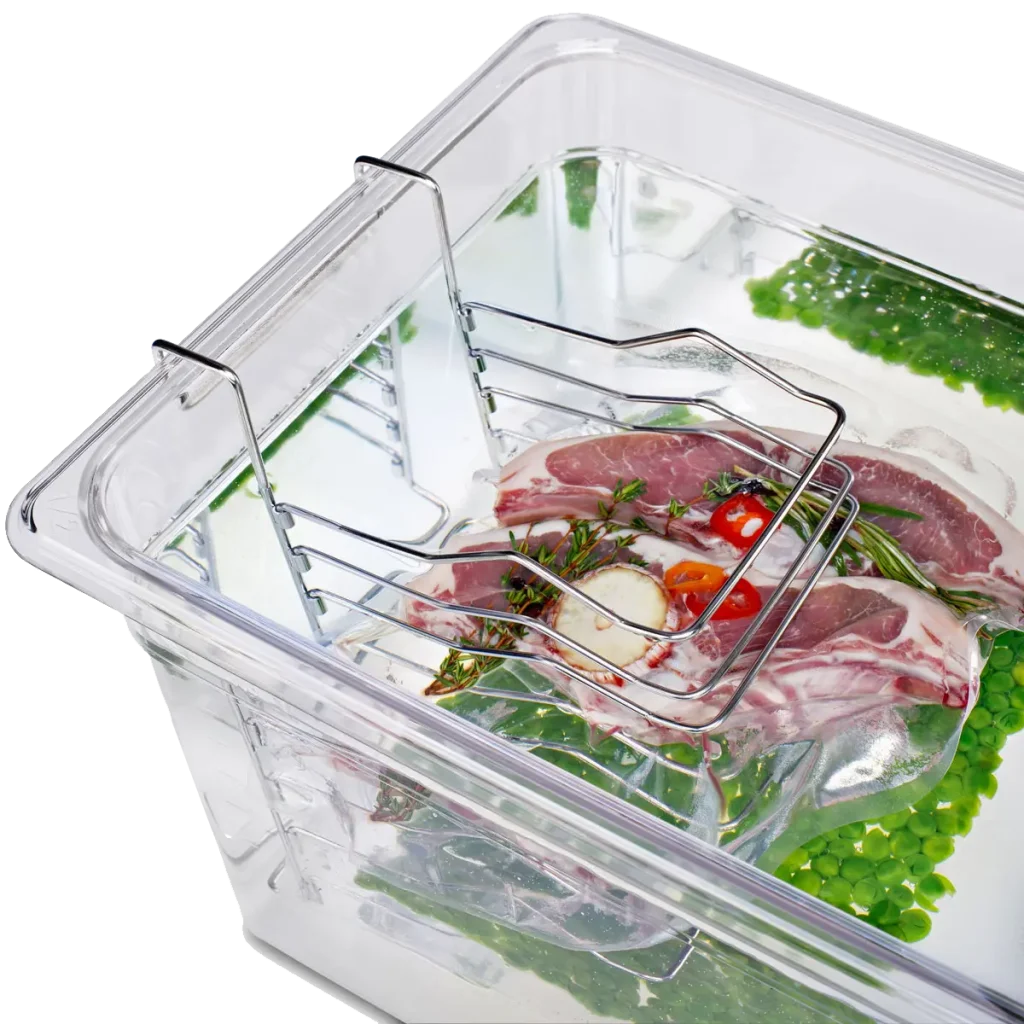
Suitable For Short Sous Vide Cooking
LAVA rates ES-Vac rolls for sous vide cooking at temperatures up to 95°C for up to two hours.
The 20cm format can accommodate T-bone steaks, pork portions, poultry, fish and vegetables that remain in a reasonably flat layer.
Before placing the bag inside a sous vide machine, inspect both seals and the complete film surface.
Do not use a package with a puncture or tear, damaged fleece layer, wrinkles crossing either seal, food or moisture trapped in the weld or a weak closure.
Bone-in food requires particular attention because a sharp point may remain under pressure throughout the cooking process.
For cooking above 70°C for longer than two hours, use specialist high-temperature cooking bags rated for the complete duration.
Dishwasher Safe And Reusable
Bags made from ES-Vac rolls are dishwasher safe and may be reused when they can be cleaned safely, remain undamaged and retain enough length for another seal.
Opening the package requires cutting away the upper weld.
The bag therefore becomes shorter after every use.
Reuse is generally most appropriate after storing dry or low-risk food.
Packaging that has held raw meat, poultry, fish, seafood or game should be discarded when it cannot be thoroughly cleaned and sanitised.
Replace any bag showing punctures, tears, damaged air channels, stretched film, persistent odours, heat-damaged areas, a weakened bottom weld or insufficient remaining length.
How Many Bags Can Two Rolls Make?
The pack provides 12 metres, or 1,200cm, of roll material.
The number of finished bags depends on the length cut for each package.
As a guide, a 20cm cut length can make approximately 60 bags, 25cm can make 48 bags, 30cm can make 40 bags, 35cm can make 34 bags, 40cm can make 30 bags, 50cm can make 24 bags and 60cm can make 20 bags.
These figures are theoretical and do not account for trimming, uneven cuts or discarded sections.
Every bag must include enough material for the product’s visible length, the product’s thickness, the bottom weld, the vacuum channel and the final seal.
A bag cut too short may be unusable even when its visible length appears to match the food.
Choosing Between The Four ES-Vac Widths
Select the narrowest roll that fits without stretching.
The 15cm roll suits cutlets, sausages, prawns and narrow trimmings.
The 20cm roll suits T-bone steaks, chops, chicken portions and small whole fish.
The 25cm roll suits larger bone-in cuts, broad fish and game portions.
The 30cm roll suits large fish, poultry, roasts and wide heavy-duty packages.
The 20cm option is a practical everyday heavy-duty width.
Choose the 15cm roll for consistently narrow products.
Move to 25cm when the portion presses against both sides or needs to be angled to fit.
Best For
- T-bone steaks and bone-in pork chops
- Chicken portions and individual ribs
- Small whole fish and spiny fish
- Shell-on seafood and smaller game cuts
Key Benefits
- 20cm practical heavy-duty width
- 160 micron Swiss-made film
- Two 6-metre rolls per pack
- Custom bag lengths for varied products
Recommended With
- Vacuum sealers with at least 20cm usable sealing width
- Heavy-duty vacuum seal rolls for other strong roll options
- Heavy-duty vacuum seal bags for fixed-size 160 micron packaging
- Sous vide machines for short controlled cooking
Frequently Asked Questions
What Products Are Best Suited To LAVA ES-Vac 20cm x 6m Rolls?
The 20cm width is suited to T-bone steaks, bone-in pork chops, chicken portions, individual ribs, small whole fish, spiny fish, shell-on seafood and game cuts.
It may also be used for industrial components and hardware that fit within the opening and require stronger airtight packaging.
The product should enter without stretching the film and leave enough material for its thickness, bottom weld and final seal.
What Is The Difference Between ES-Vac And E-Vac 20cm Rolls?
Both products contain two 20cm x 6m rolls, providing 12 metres of material.
Standard E-Vac uses 90 micron film and is intended for boneless meat, smooth fish, cheese, vegetables and ordinary food storage.
ES-Vac uses 160 micron film and is approximately 75% thicker.
It is intended for bones, fins, shells, game fragments, hardware edges and extended freezer storage.
Are LAVA ES-Vac Rolls Puncture-Proof?
No vacuum packaging is completely puncture-proof.
The 160 micron film provides greater resistance than standard 90 micron packaging, but extremely sharp bones, shell points, hooks and metal edges may still damage it.
Remove, cover or reposition sharp areas and inspect the package after vacuuming and freezing.
Will My Vacuum Sealer Seal 160 Micron Rolls?
All LAVA vacuum sealers are designed to seal ES-Vac film.
For a non-LAVA machine, check the maximum supported film thickness.
Some consumer machines are limited to approximately 90 to 120 microns.
An underpowered machine may remove the air but create a weak or incomplete weld.
Do I Need To Change The Sealing-Time Setting?
A longer sealing time is normally required because ES-Vac is thicker than standard E-Vac film.
On an adjustable LAVA machine, begin approximately one or two positions above the usual E-Vac setting and inspect the cooled weld.
Increase or reduce the heat gradually according to the seal quality and the machine manufacturer’s instructions.
Can ES-Vac Rolls Be Used In A Chamber Vacuum Sealer?
They may be sealed in a chamber machine when the finished bag fits inside the chamber and across its sealing bar.
However, chamber machines do not require textured channels.
Smooth chamber pouches are generally more economical for businesses using chamber equipment exclusively.
ES-Vac remains useful when custom length, heavier film or compatibility with an external vacuum sealer is required.
Can I Use ES-Vac For Boneless Food?
Yes. ES-Vac can package boneless meat, cheese, vegetables and smooth fish.
However, standard E-Vac is normally more economical when the food has no bones, fins, shells or hard edges.
Choose ES-Vac for boneless food when the package will be handled heavily or stored for an extended period.
Are These Rolls Suitable For Sous Vide Cooking?
Yes, for shorter cooking applications.
LAVA rates ES-Vac for temperatures up to 95°C for up to two hours.
Inspect the film and both seals before cooking.
For recipes above 70°C lasting longer than two hours, use specialist high-temperature packaging.
Can Bags Made From ES-Vac Rolls Be Reused?
Yes, when the bag can be cleaned safely, remains undamaged and retains enough length for another seal.
The bag becomes shorter each time the upper weld is removed.
Reuse is most suitable after dry or low-risk products.
Discard packaging that cannot be thoroughly cleaned after holding raw meat, poultry, fish, seafood or game.



Reviews
There are no reviews yet